
Turning the Tables on Tough Recoveries
Most towing calls are straightforward. A disabled vehicle on a flat shoulder. A broken-down car in a parking lot. A light-duty roadside assist. Standard equipment handles these cases without complications. When something goes wrong that puts a vehicle beyond the reach or angle of conventional rigging, the job changes. Our Ash Fork rotator service exists for exactly those calls: the recoveries where everything else has already been ruled out.
So… What Is a Rotator, Actually?
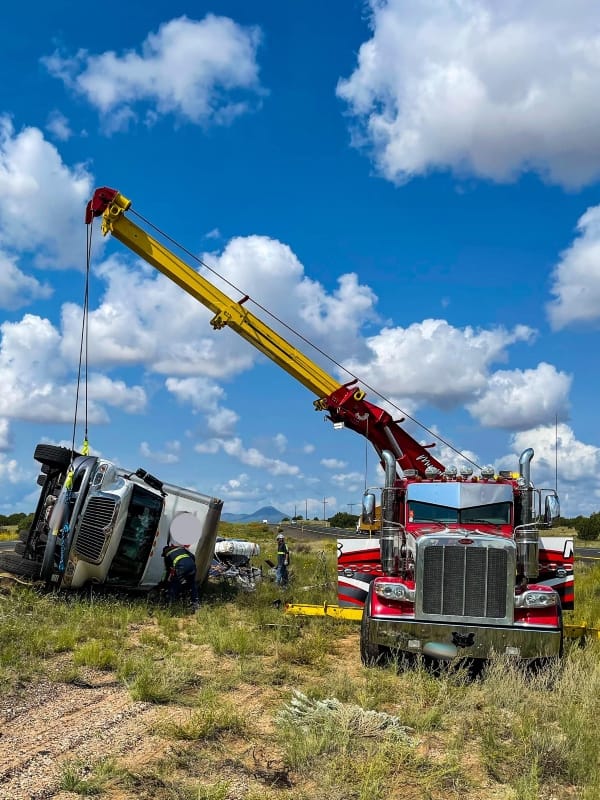
Simply put: A rotator is a heavy-duty recovery truck built around a boom that can rotate a full 360 degrees. Conventional wreckers can only pull or lift from a fixed alignment with the stuck vehicle. But a rotator can work from virtually any angle around it. That capability opens recoveries that would otherwise be impossible: vehicles pinned against highway barriers. Equipment that has gone deep into rocky terrain. Or loaded commercial trucks that have rolled or gone over an embankment on mountain roads.
When the Terrain or the Position Rules Out Everything Else
A jackknifed semi on a narrow grade, a vehicle that has gone down a rocky embankment, or heavy equipment that has tipped in a confined construction area are the calls our Ash Fork rotator service responds to when other options are not viable.
The threshold is not always terrain. Any incident where the stuck vehicle cannot be approached from a standard angle, where surrounding obstacles prevent conventional rigging, or where the weight and position require a controlled multi-point lift falls within rotator territory. Our dispatchers confirm those variables before the truck leaves. Because arriving with the wrong unit at a complex recovery costs time and can compromise what is already an unstable scene.
What a Rotator Changes for the Vehicle Being Recovered
A vehicle in a complex recovery position faces additional risk if the rigging geometry is wrong. Pulling from the incorrect angle can shift weight unexpectedly. We risk causing further movement, or placing stress on structural points that were not designed to take a directional load. Our Ash Fork rotator service operators use the rotating boom to establish the optimal angle before any force is applied, stabilizing the vehicle first and removing it in a way that limits additional damage to the frame, suspension, and drivetrain.
Situations That Typically Call for a Rotator
Not every call needs one, but these scenarios consistently do:
- Rollover incidents involving semis, commercial trucks, or large equipment
- Vehicles that have gone off embankments or into rocky terrain on I-40 or mountain roads
- Jackknifed commercial trucks on narrow grades or in confined areas
- Heavy equipment that has tipped or shifted in a tight recovery position
- Multi-vehicle incidents where standard access to the stuck vehicle is blocked
- Any recovery where the load must be controlled throughout the full lift cycle
Our Ash Fork rotator service crew assesses the scene on arrival and confirms the rigging plan before any lift begins.
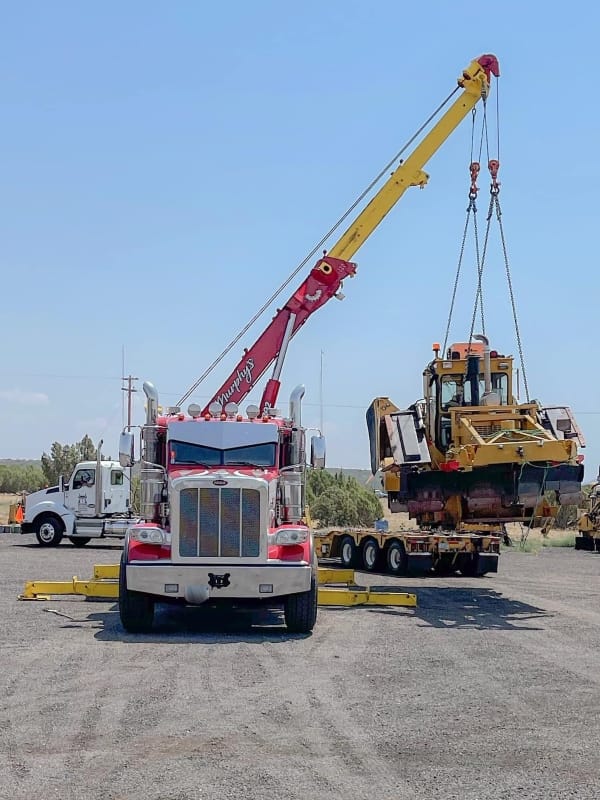
Murphys Heavy Towing: Your Ash Fork Rotator Service for Northern Arizona’s Toughest Recoveries
Murphys Heavy Towing, Off-Road Recovery & Semi Truck Repair has been operating since 2014 as a family-owned provider across Flagstaff, Williams, Ash Fork, Holbrook, and the surrounding region. Our ASE-certified operators bring real experience with complex off-road and highway recoveries across Northern Arizona’s terrain. Our Ash Fork rotator service is part of a full fleet that includes heavy wreckers, off-road recovery rigs, and diesel roadside support.
When a complex call comes in from I-40, a mountain grade, or a remote location, our Ash Fork rotator service team shows up with the right equipment and the training to use it correctly. Honest assessments, fair pricing, and no shortcuts on scene are how we have earned the trust of drivers, fleets, and agencies across Northern Arizona since we opened.
FAQ
How is a rotator different from a standard wrecker?
A standard wrecker can lift and pull from a fixed position in front of or behind the truck. A rotator’s boom pivots a full 360 degrees, letting the operator apply force from almost any angle without repositioning the truck itself. That makes it useful when a vehicle is in a position that a wrecker cannot align with or when obstacles prevent the truck from getting close enough to rig conventionally.
How much weight can a rotator lift?
Heavy-duty rotators are typically rated for 50 to 75 tons of lift capacity, with some larger units exceeding that depending on the configuration. The actual safe working load on any given call depends on the boom angle, extension, and rigging setup rather than just the truck’s rated capacity. Operators calculate load limits before each lift to stay within safe working range.
How long does a rotator recovery take compared to a standard tow?
There is no fixed answer because complexity drives duration. A straightforward flatbed tow might take 30 minutes. A rotator recovery of a rolled semi on a mountain road can take several hours, including scene setup, rigging, the lift itself, and repositioning the vehicle to a point where it can be transported. Dispatch updates are part of the process for longer recoveries.
Can a rotator be used on steep or rocky terrain?
Yes. Rotators are specifically suited for terrain recoveries where the truck cannot drive close to the stuck vehicle. The extended rotating boom can reach into gullies, down embankments, and across terrain obstacles to rig a vehicle without requiring the rotator itself to be on unstable ground. The truck is staged on firm, accessible ground while the boom does the reaching.
What training does a rotator operator need?
Rotator operation requires advanced training beyond standard towing certifications. Most professional operators hold WreckMaster certification at an advanced level, which covers rigging calculations, load dynamics, complex vehicle positioning, and scene safety for large recoveries. Operating a rotator incorrectly can cause serious damage or injury, so verified training and field experience matter significantly.